Rhododendron boninense
Billeder af Rhododendron boninense
Beskrivelse
R. boninense (Tsutsusi). Ikke hårdfør i Danmark.
Hans Eiberg
info page 55 R. boninense
Denne art er endemisk i Tokyo-præfekturet. Ikke Tokyo på fastlandet, men de tilstødende øer Chichijima, som ligger 1000 km (620 mi) direkte syd for Tokyo i Stillehavet. De er kendt som Ogasawara-øgruppen, eller Bonin-øerne, og de består af 30 tropiske øer, der betragtes som en del
af Tokyo præfekturet. R. boninense findes kun på Chichijima, el “Father Island,” på solrige klipper. Der er et enkelt eksemplar tilbage, som stadig vokser ind den vilde, men Koishikawa Botaniske Have, som støder op til Universitetet i Tokyo, har arbejdet på ex-situ-bevaring af tolv truede arter, der er endemiske for Ogasawara-øgruppen, herunder R. boninense, siden 1987.
Se mere under info page 55 i JARS
Rhododendron boninense
This species is endemic to Tokyo prefecture. Not the Tokyo on the mainland,
but the adjacent islands which are located 1000 km (620 mi) directly south of
Tokyo in the Pacific Ocean. They are known as the Ogasawara archipelago, or
Bonin Islands, and they consist of 30 tropical islands that are considered part
of Tokyo prefecture. Rhododendron boninense is found only on Chichijima, or
“Father Island,” on sunny rocks. There is a single specimen left that still grows in
the wild, but Koishikawa Botanical Garden, which is adjacent to the University
of Tokyo, has been working on ex-situ conservation of twelve endangered
species endemic to Ogasawara archipelago, including R. boninense, since 1987.
Rhododendrons International 55
It has been reported that this species is
extremely difficult to grow outside the
Ogasawara archipelago due to the lack
of laterite (clay that is rich in iron and
aluminum) that naturally occurs in the
region. It belongs in subgenus Tsutsusi,
section Tsutsusi, and the closest relative
of this species is Rhododendron scabrum
which also is found in Japan. The species
name “boninense” comes from the
word “Bonin” the other name for the
Ogasawara archipelago. In fact, there are
several genera that occur in the region
with the same species name, including
R. boninense. Photo: Botanical
Gardens, Graduate School of Science,
The University of Tokyo.
Vaccinium boninense, that are also endemic to the same location. The Ogasawara
archipelago has roughly 400 native plants, and 150 of those are endemic to the
location. Rhododendron boninense is an evergreen azalea with a mature height of
1.5 to 2.5 m (5 to 8 ft).
The alternate leaves of R. boninense are oblong-lanceolate and are 3.5 to 6 cm
(1.4-2.4 in) long and 1 to 1.5 cm (0.4-0.6 in) wide, with petioles that are 0.5 to 1
cm (0.2-0.4 in) long. The margin is entire. The texture is thick and leathery. The
branches, petioles, and lower surface of the leaves, especially along the midrib, are
covered with dense adpressed hairs that are brownish in color.
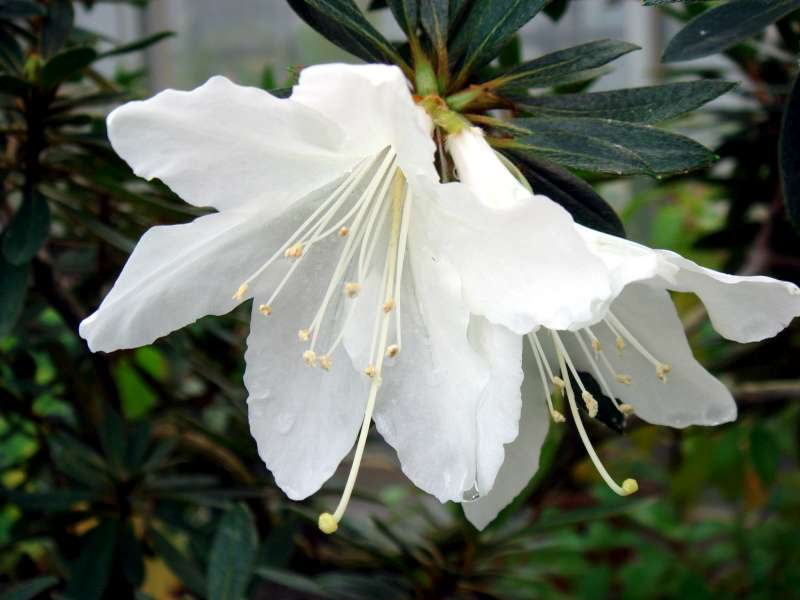
The funnel-campanulate shaped inflorescence is 4 to 5 cm (1.6-2 in) across and
2.5 cm (1 in) long. The pure white, five-lobed corolla is dissected to about half of
the length. Inside, the corolla is pilose, but the outer surface is glabrous. Two to
three flowers are produced from a single terminal bud. The calyx is strigose and
about 2 mm (0.08 in) long. The pedicel is 4 to 6 mm (0.15-0.24 in) long. There
are seven to ten stamens with a strigose ovary. It blooms in April.
There are several reasons why R. boninense is a critically endangered species.
Typhoons and other natural disasters (such as drought and changing climate)
are directly related to this species being threatened. The roots are washed off and
branches are broken from the heavy storms. R. boninense has also suffered from
the attacks of gall mites and goats. Naturally, the need of conservation of this
species is well-recognized in Japan.